Mittenda Limited, the specimen firm.
In the fiction: Mittenda Limited is a mid-size payment institution established in Dublin, Ireland, also authorised as a crypto-asset service provider, moving funds and crypto-assets for consumers and small businesses. Its crypto-asset services arrived in 2025, and its document estate shows the rail being added: mature payments documents, young crypto ones.
In reality: no such firm exists. Mittenda is a synthetic institution invented by OpusDatum so that a complete compliance demonstration can be published, cited clause by clause, and clicked through without a word of client material. The documents contain deliberate deficiencies; they exist to be diagnosed, not adopted. One of them carries a seeded gap that OpusDatum's published findings letter works through.
The chain of proof, in order
Six things are published here, and each one rests on the one before it. The firm's documents are the input; the findings are the output; the OpusDatum Risk obligations register is what the findings are anchored to; the working papers and the tool screens are the step in between, written down and shown.
- The firm's documentsTwelve excerpts, in three tiers, each watermarked as synthetic.12 PDFs
- The findings letterStage one: what the governing tier evidences, and what it does not.PDF, 2 pages
- The risk-assessment recordStage two: one finding taken through analysis, evaluation and treatment.PDF, 3 pages
- The register extractThe one risk the letter leads with, as the OpusDatum Risk obligations register holds it.PDF
- The working papersHow twelve documents became a finding, and how far a documents review reaches.Web page
- The tool screensThe product pages that hold the evidence, captured read-only.33 pages
Five minutes: the letter. Twenty: the letter, the record, and the citation index beside them, which lists every clause they quote. An hour: the working papers, then the tool screens.
Read the findings
Every clause the letter and the record quote is listed, with the document it comes from, on the citation index. It runs the other way too: from a document back to the finding that quotes it.
The document estate
The governing tier answers to the board and the regulator; the operational tier runs the rails; the business-wide risk assessment records what the firm believes its risks are. Published as excerpts, exactly as the specimen findings cite them, each watermarked as synthetic.
| Reference | Document | Tier | |
|---|---|---|---|
| MTD-FRM-01 | Financial Crime Framework (v1.2) | Governing | |
| MTD-POL-01 | AML/CTF Policy (v4.2) | Governing | |
| MTD-POL-02 | Record Retention Policy (v1.4) | Governing | |
| MTD-POL-03 | Risk Appetite Statement (v2.0) | Governing | |
| MTD-STD-01 | Customer Due Diligence Standard (v2.0) | Governing | |
| MTD-STD-02 | Transaction Monitoring Standard (v2.3) | Governing | |
| MTD-STD-03 | Sanctions Screening Standard (v5.3) | Governing | |
| MTD-STD-04 | Transfers of Funds and Crypto-Assets Standard (v3.2) | Governing | |
| MTD-RSK-01 | Business-Wide Financial Crime Risk Assessment (v3.0, 2025 cycle) | Assessment | |
| MTD-PRC-01 | Payments Operations Procedure (v3.1) | Operational | |
| MTD-PRC-02 | Crypto-Asset Transfer Operations Procedure (v1.7) | Operational | |
| MTD-TEC-01 | Payment Platforms Design Note (v2.1) | Operational |
The diagnostic reads the governing tier; the operational tier enters at stage two, where the assessed risks point. Why synthetic institutions exist at all is set out at opusdatum.com/synthetic.
Working papers
The documents are the input and the published findings are the output. The step between them is OpusDatum's, and it is written down rather than asserted: what was read and in what order, the four answers a coverage review gives, how a clause is matched to a duty by what it is about, and how far a review of documents reaches before it has to stop. Read the working papers.
Written by OpusDatum about the demonstration, not by the firm. Mittenda has no voice outside its own documents.
See the work in the tool
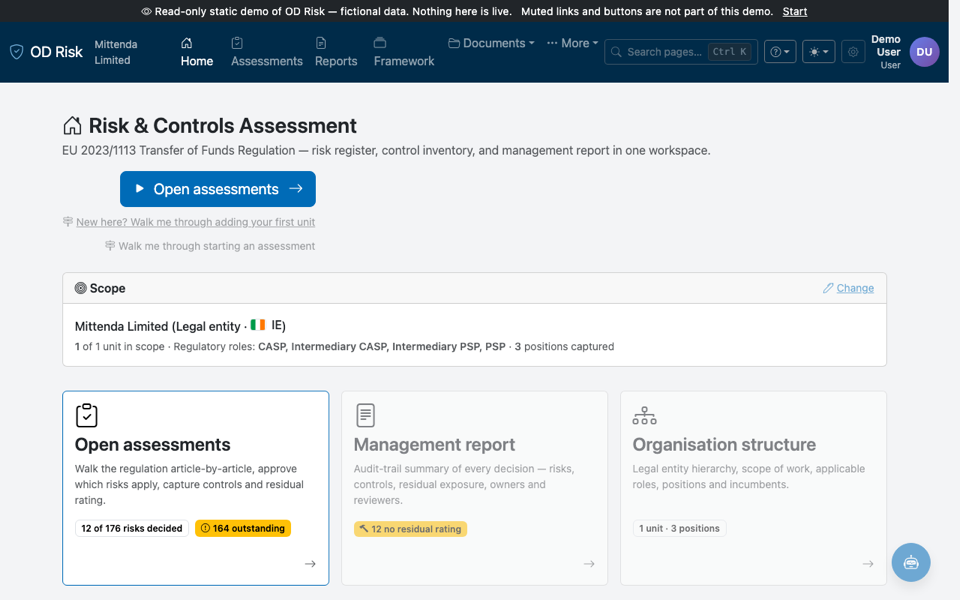
The screens below are real pages of OD Risk, OpusDatum's assessment tool, captured read-only after it had read Mittenda's twelve documents and mapped them against that register. Nothing on them is live, and the reviewer is shown as a placeholder name. Five screens carry the thread from the documents to the finding; the rest can be browsed from the tool's own start page.
- The document registerThe twelve documents as the tool registered them, with the tier of each and what was mapped from it.
- The worked riskThe verification risk the letter leads with, as the tool holds it: its description, its designation and its steps.
- The findingThe examination that reached "documented, not evidenced": the duty, what was searched, and what each document shows.
- Every finding the run raisedThe queue of findings from the documents, each with its coverage verdict and its review state.
- Coverage and gapsThe register's view: which duties, controls and risks the accepted evidence reaches.
Or start at the tool's home page and browse all 33 pages. Links to pages outside the capture are muted and go nowhere.
Why this site exists
Compliance proof usually hides behind redaction. OpusDatum publishes the whole demonstration instead: a synthetic firm honest about being synthetic, its documents in full excerpt, the findings a real method produces against them, and the screens the method ran on. What is real here is the method, the tool, and the OpusDatum Risk obligations register they draw on; the firm is the specimen.